Coffee Station Organizers for Coffee Bar Storage and Selection
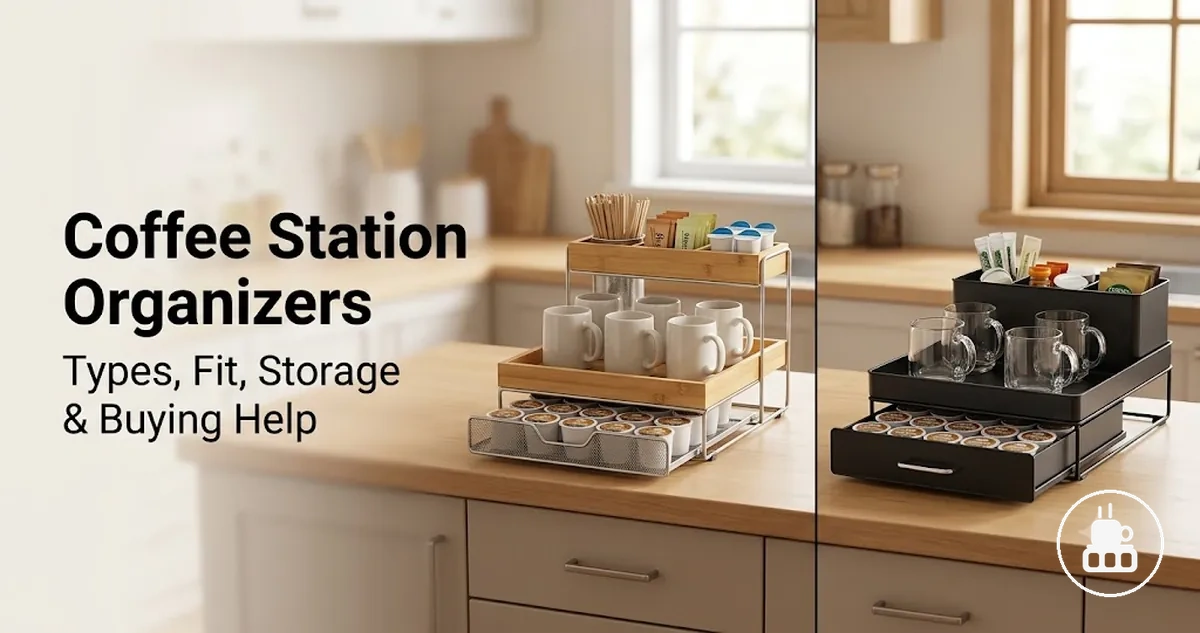
Choose a coffee station organizer by first checking the usable counter width, depth, height and access space, then matching the storage format to the supplies you reach most often. Use a drawer for concealed pods and small items, tiered or shelf storage for visible vertical access, a caddy or tray for grouped items, and a compact format when footprint is the main constraint; whichever format you choose should not block the coffee machine, outlets, cabinets or the normal reach path.
Find a suitable organizer format
Select the counter constraint, the supplies you store most, and the access style you prefer. The result is a starting profile based on the format, fit, capacity and access relationships explained on this page; verify the dimensions of any specific product before buying.
Starting profile: Select the three criteria above.
The selector narrows the storage format; it does not replace physical measurement or product-specific checks.
- Measure the usable placement zone before selecting a product.
- Keep machine controls, water access, outlets and cabinet movement unobstructed.
- Choose enough capacity for regular-use supplies without crowding retrieval.
Use the rest of the guide in decision order: understand the organizer's role, compare formats, verify physical fit, match compartments to supplies, check material and maintenance trade-offs, then apply the buying criteria to any product example.
What a Coffee Station Organizer Does
A coffee station organizer is a countertop storage unit for keeping frequently used coffee supplies together near the brewing area. Its main value is organized access with less scattered clutter; it normally stores accessories rather than the coffee machine itself.
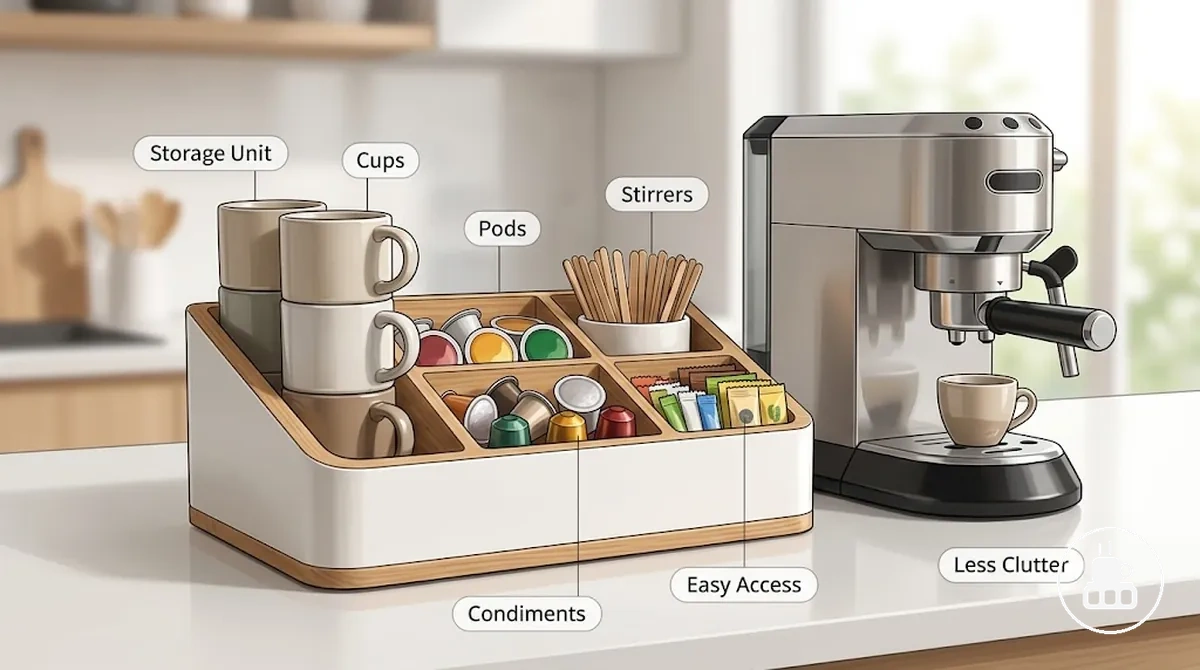
The image shows the core relationship: the organizer groups supplies into defined storage areas so each item type has a predictable place and remains easier to retrieve during normal use.
Organizer role at a glance
Group everyday coffee supplies in one accessible countertop zone.
Cups or mugs, pods or capsules, stirrers, sweeteners and other small condiments.
Supports access and clutter control; it does not replace cabinetry, appliance placement or a complete coffee-station layout.
Organizer Types, Formats, and Storage Boundaries
Organizer formats mainly differ by storage visibility, vertical use, footprint, portability and access pattern. Compare those attributes before treating one format as “better” than another.
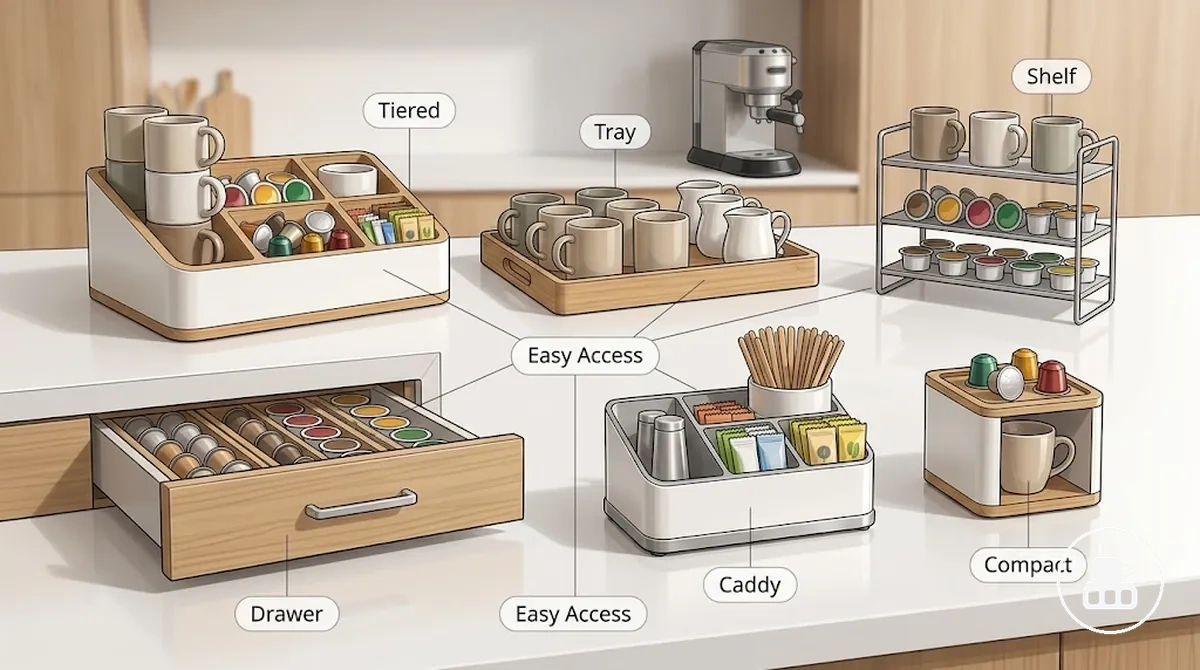
Use the matrix to match each format to the physical and access condition it handles best. The entries describe format-level tendencies, not specifications for every product.
| Format | Main storage attribute | Space effect | Best use case |
|---|---|---|---|
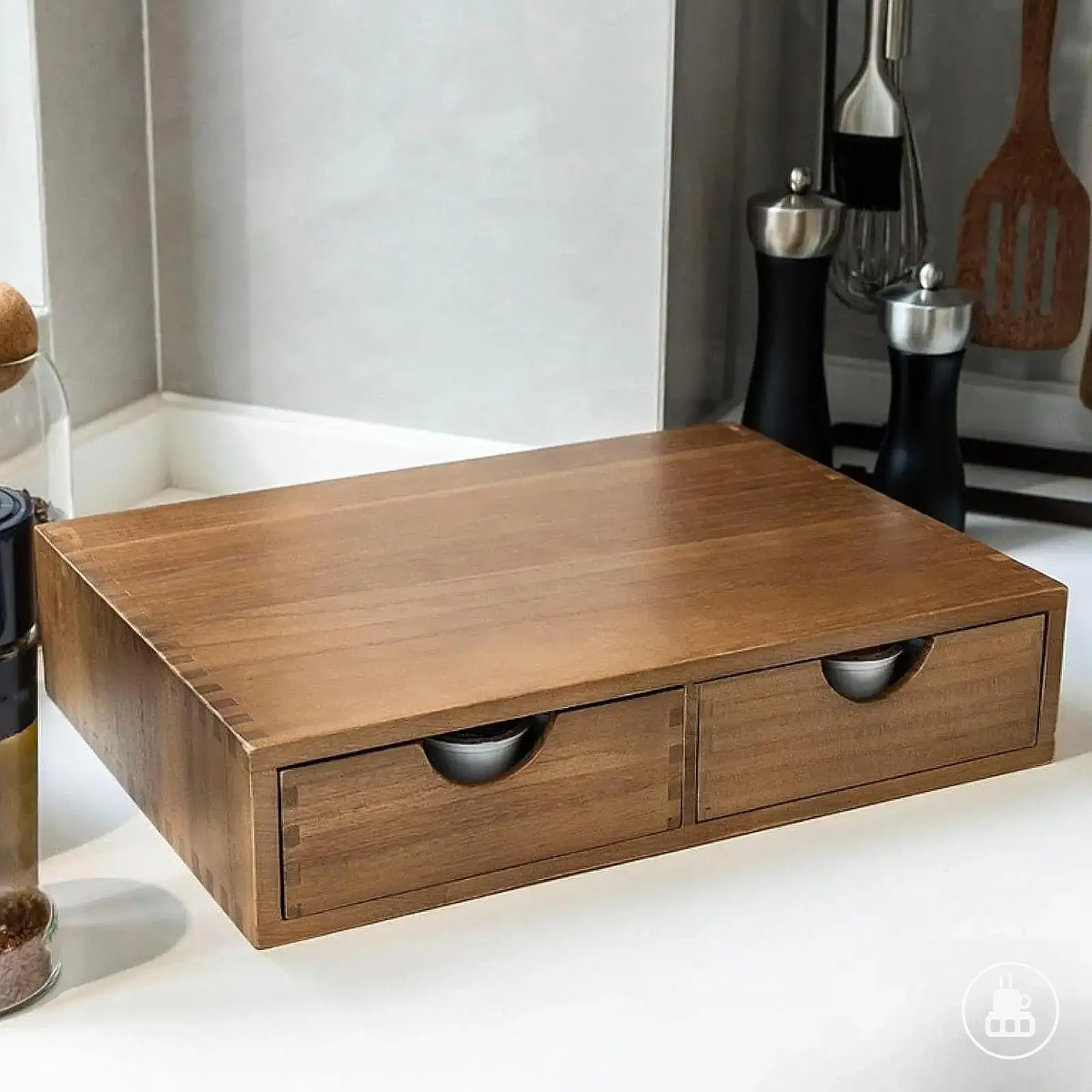
| Drawer | Concealed pull-out storage for pods and small supplies | Needs its own footprint and pull-out clearance | When concealed storage and quick small-item access are priorities |
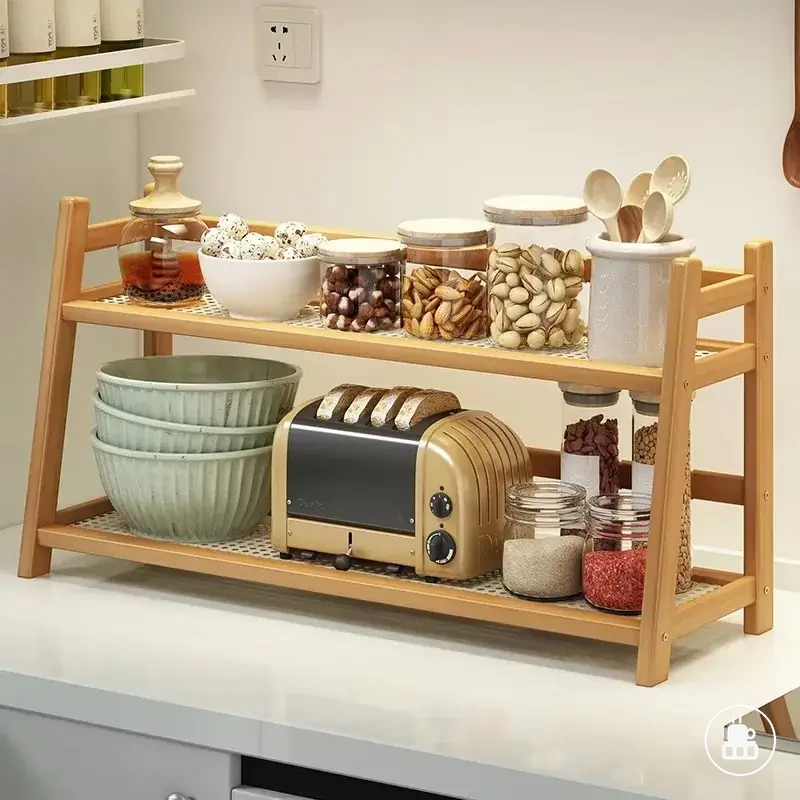
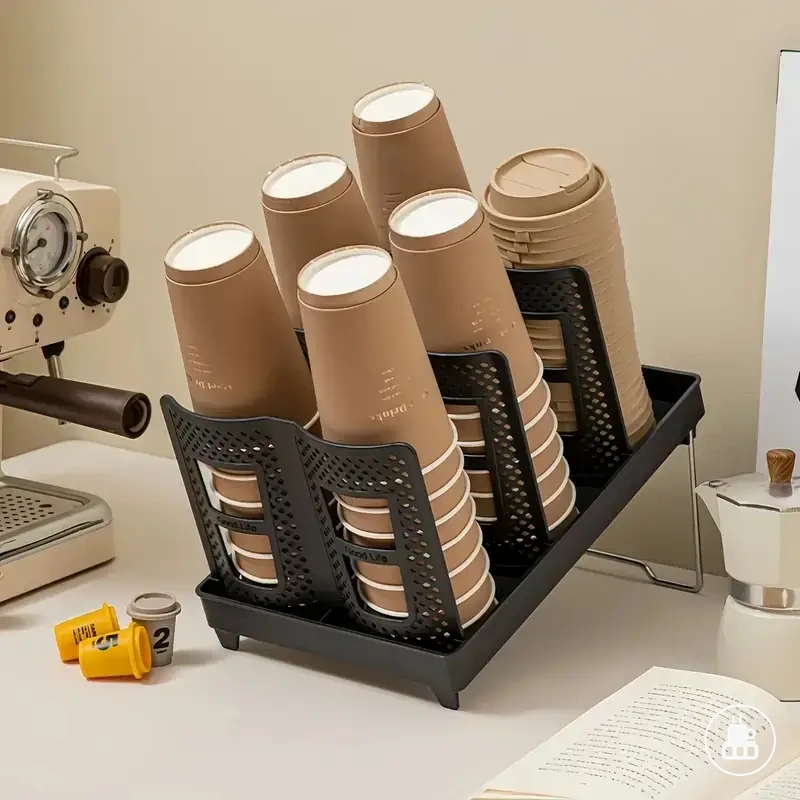
| Tiered | Open vertical storage with high visibility | Uses height to add capacity; needs overhead clearance | When cups and frequently used supplies should remain visible |
| Tray | Open grouped surface | Defines a zone but adds little vertical capacity | When supplies are moved or regrouped regularly |
| Caddy | Divided compartments for small items | Keeps a compact footprint for packets and stirrers | Shared stations or condiment-heavy setups |
| Shelf | Open layered surfaces | Adds vertical storage; needs enough height above it | Frequently used cups, jars or mixed visible supplies |
| Compact countertop | Reduced-footprint storage | Preserves more work surface but usually limits total capacity | Small or shared counters with lighter supply volume |
The clearest trade-off is concealment versus visibility. Drawer formats hide pods and small accessories but need pull-out room; tiered and shelf formats expose supplies and use vertical space, so overhead clearance matters.
Tray and caddy formats solve a different task: they keep related supplies together and can be easier to reposition. A compact format reduces footprint, but reduced size can also reduce usable capacity, so it works best when only regular-use supplies stay on the counter.
If you need more detail about individual storage formats, continue to coffee station organizer types. That page expands on each organizer format while this section remains focused on category-level differences.
Counter Fit, Dimensions, and Placement Conditions
Physical fit has two parts: the organizer must fit within the usable width, depth and height, and its drawers, doors or stored items must remain reachable in the surrounding space. A product can fit by dimensions yet still be unsuitable if it blocks normal coffee-machine use or nearby fixtures.
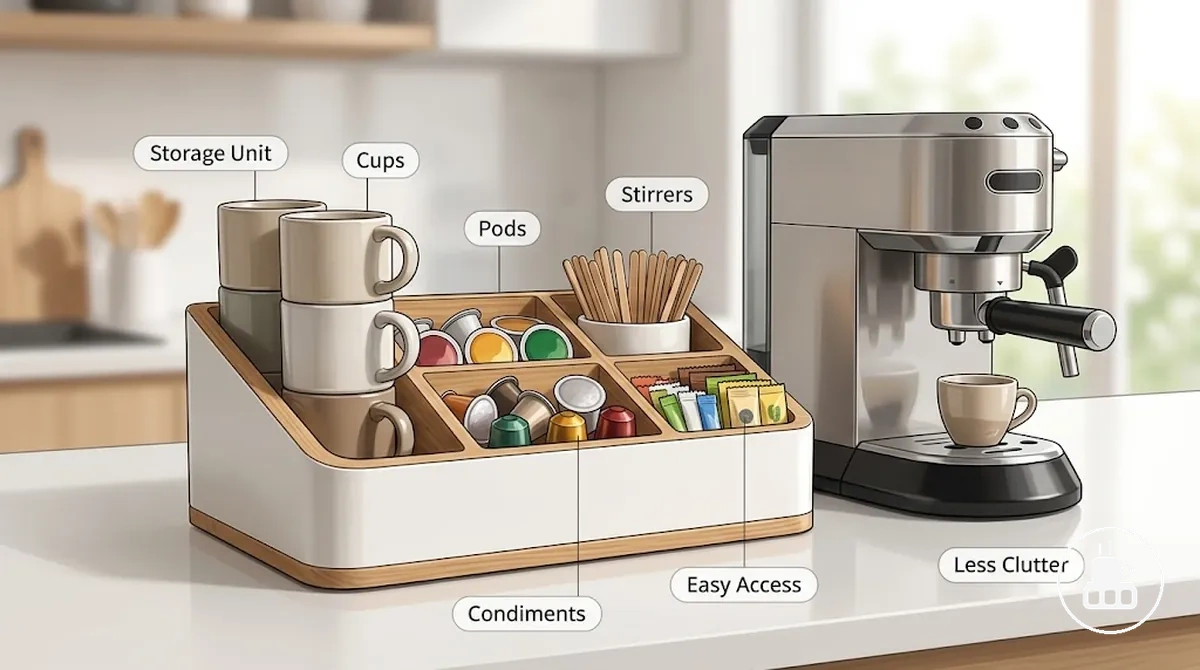
Measure the placement zone first, then verify each access condition below against the organizer's external dimensions and moving parts.
- Width: the organizer must fit inside the usable horizontal space without crowding neighbouring equipment.
- Depth: the organizer should sit fully within the usable counter depth and preserve the normal work edge.
- Height: the organizer and its tallest stored item must clear overhead cabinets or shelves.
- Moving access: drawers, lids or removable bins need enough room to open or lift without obstruction.
- Power access: nearby outlets and plugs should remain reachable and unobstructed.
- Coffee-machine access: controls, water tanks, pod doors, carafes and drip trays should still move normally.
- Reach path: frequently used supplies should be retrievable without reaching across hot, wet or awkwardly placed equipment.
A practical fit rule is simple: usable placement dimensions must exceed the organizer’s occupied dimensions wherever access or movement is required. On a small, corner or shared counter, prioritise the smallest footprint that still holds regular-use supplies without blocking the coffee workflow.
For more detailed measurement planning, see coffee station organizer dimensions and fit. It explains how organizer dimensions and surrounding clearance work together when evaluating physical fit.
Compartments, Capacity, and Supply Matching
Capacity is useful only when the compartments match the size, shape, quantity and access frequency of the supplies you actually keep at the station. More compartments or a larger organizer do not improve storage when they create unused space or force regular-use items into awkward positions.
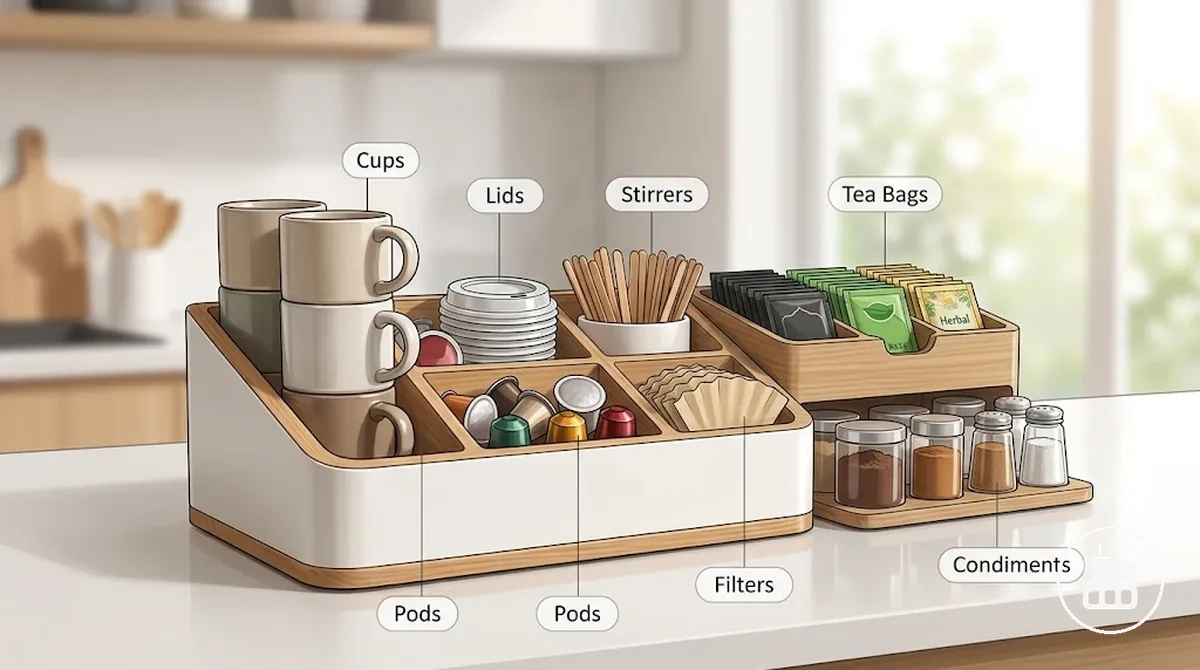
Match each supply group to the compartment property that lets it be stored without wedging, mixing or blocking retrieval.
| Supply | Useful compartment attribute | Capacity condition | Practical result |
|---|---|---|---|
| Pods or capsules | Divided slots, bins or a dedicated drawer | Holds the regular refill quantity without overfilling | Faster sorting and retrieval |
| Cups or mugs | Open section with enough width and height | Fits the largest regularly stored cup without wedging | Stable, accessible cup storage |
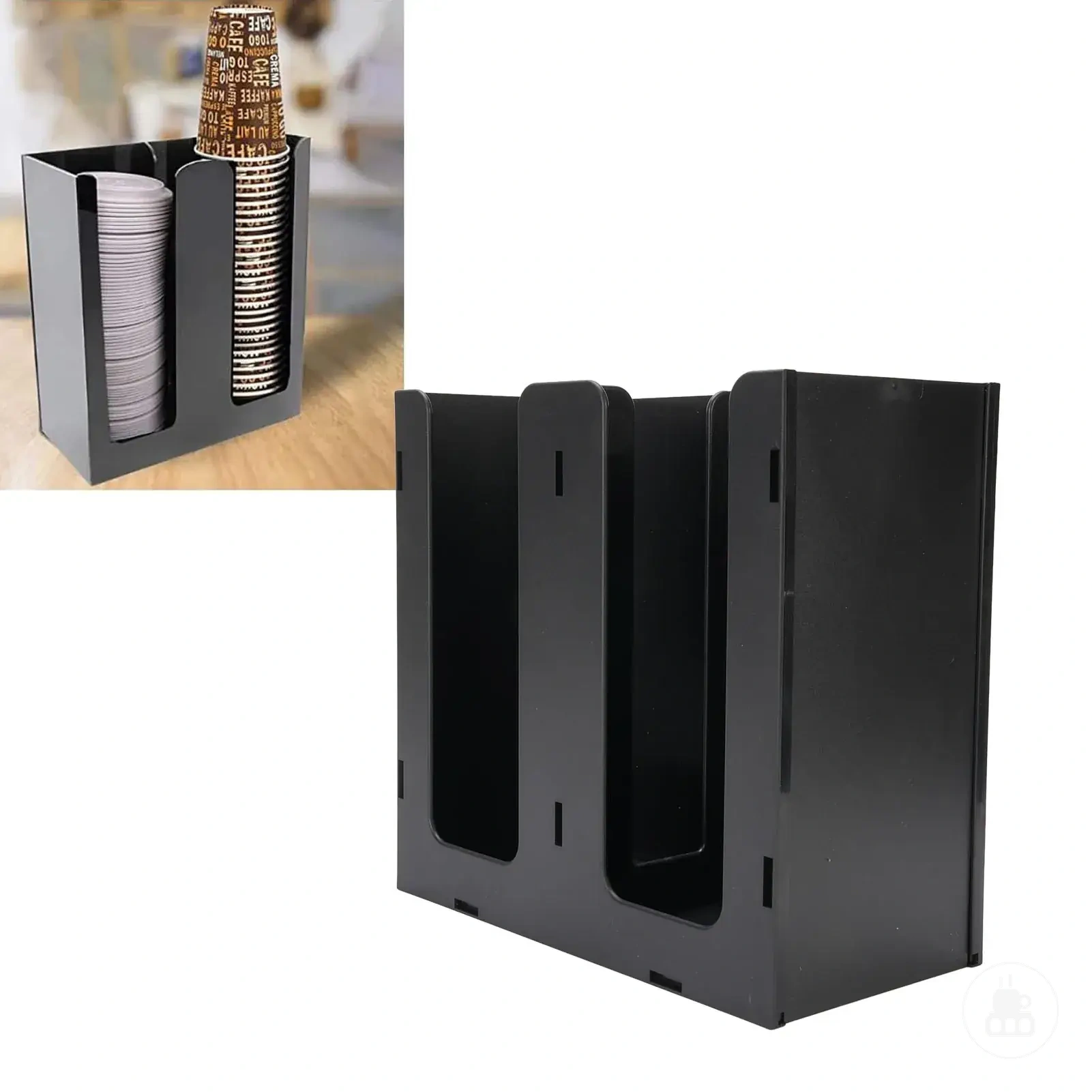
| Lids | Flat or upright divider matched to lid size | Keeps matching lids together without bending | Less mixing with other supplies |
| Stirrers | Narrow upright compartment | Tall enough to contain them while leaving tops easy to grasp | Quick retrieval with little footprint |
| Sweetener packets | Small divided section | Holds normal-use quantity without compressing packets | Separate, visible supply groups |
| Filters | Dry flat or upright storage | Keeps the filter shape intact and away from splashes | Less crowding and easier replenishment |
| Tea bags | Separate dry compartment | Enough separation to keep varieties or drink types distinct | Clearer shared-station organisation |
| Small condiments | Compact, easy-to-clean bin or divider | Supports frequent refilling without blocking adjacent items | More orderly access and simpler refills |
Capacity is sufficient when regular-use supplies fit without stacking, crushing or blocking one another. Keep surplus stock elsewhere when adding it would make everyday items harder to see or reach; flexible dividers are useful when cup sizes, capsule types or refill habits change.
Capacity planning works best when storage space matches the supplies you actually keep available. For more detailed planning, see coffee station organizer compartments and capacity to compare compartment layouts with different supply needs.
Materials, Durability, and Finish Trade-Offs
Material affects cleaning effort, moisture tolerance, rigidity, weight and appearance, but construction quality and surface finish also matter. Match the material to the placement environment and handling pattern rather than choosing by finish alone.
| Material | Useful attribute | Main trade-off | Better-fit condition |
|---|---|---|---|
| Wood | Warm appearance and rigid structure | Moisture resistance depends heavily on seal or finish; spills need prompt wiping | Dry to moderately used visible coffee bars |
| Bamboo | Natural appearance with relatively light construction | Surface finish and joints affect moisture resistance and long-term maintenance | Dry counters with routine wiping |
| Acrylic | Clear visibility and a smooth wipeable surface | Scratches, fingerprints and water marks can remain visible | When seeing contents quickly is a priority |
| Plastic | Lightweight and generally easy to wipe | Rigidity, heat tolerance and appearance vary by formulation and construction | Frequent repositioning and everyday storage |
| Metal | High rigidity and durable construction | Can be heavier; moisture performance depends on metal type and coating | Shared or frequently handled counters where stability matters |
Decision rule: choose the material whose routine cleaning and moisture exposure you can realistically manage; appearance is secondary when the organizer sits beside water, steam or frequent spills.
Wood and bamboo can suit visible stations when a warmer appearance matters, while acrylic keeps contents easy to scan. Plastic is useful when low weight and easy repositioning matter; metal generally offers greater rigidity but can add weight.
For any material, surface finish, joints and construction quality can change the real cleaning and durability outcome. In splash-prone areas, wipe spills promptly and follow the specific product’s care instructions rather than assuming every wood, bamboo, plastic or metal organizer behaves the same way.
Daily Access, Clutter Control, and Setup Limits
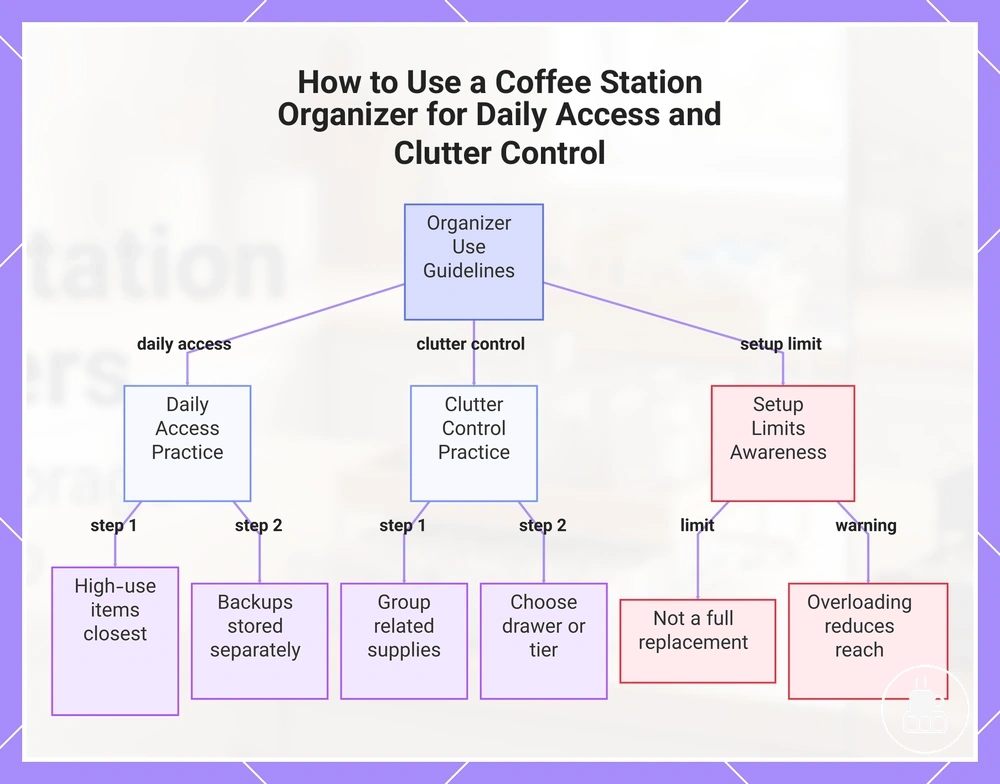
Daily access improves when storage position follows use frequency and reach: items used for most drinks belong closest to the brewing area, refills should remain easy to replenish, and backup stock can sit farther away. Clutter control is useful only when grouping makes retrieval easier.
- High-use zone: keep cups, pods and other frequent items closest to where drinks are prepared.
- Refill zone: keep replenishment supplies accessible without placing them in the primary reach path.
- Backup zone: move surplus stock off the main counter when it is not needed for routine use.
- Grouping: store related items together so a visual scan reveals what is available and what needs refilling.
- Access style: choose drawer concealment, open tiers, shelves, trays or caddies according to the routine rather than display preference alone.
On small counters, the benefit of an organizer disappears if it consumes the workspace needed to operate the machine. Keep the regular-use zone compact and move backup quantities elsewhere before increasing the organizer footprint.
Overfilling reverses the organizer’s main benefit: visibility drops, retrieval slows and refilling becomes harder. Leave enough open access to remove one item without disturbing several others.
The organizer supports supply access; it does not define the full appliance, water, waste or serving layout. For the broader process, see how to set up a coffee station organizer.
For a visible or shared coffee bar, appearance can be considered after access and fit. coffee station organizer ideas can help with presentation without replacing the functional storage criteria.
The chart below visualises the same access sequence: keep routine supplies closest, separate backups, preserve refill paths and avoid crowding.
Buying Criteria for a Better Coffee Station Organizer
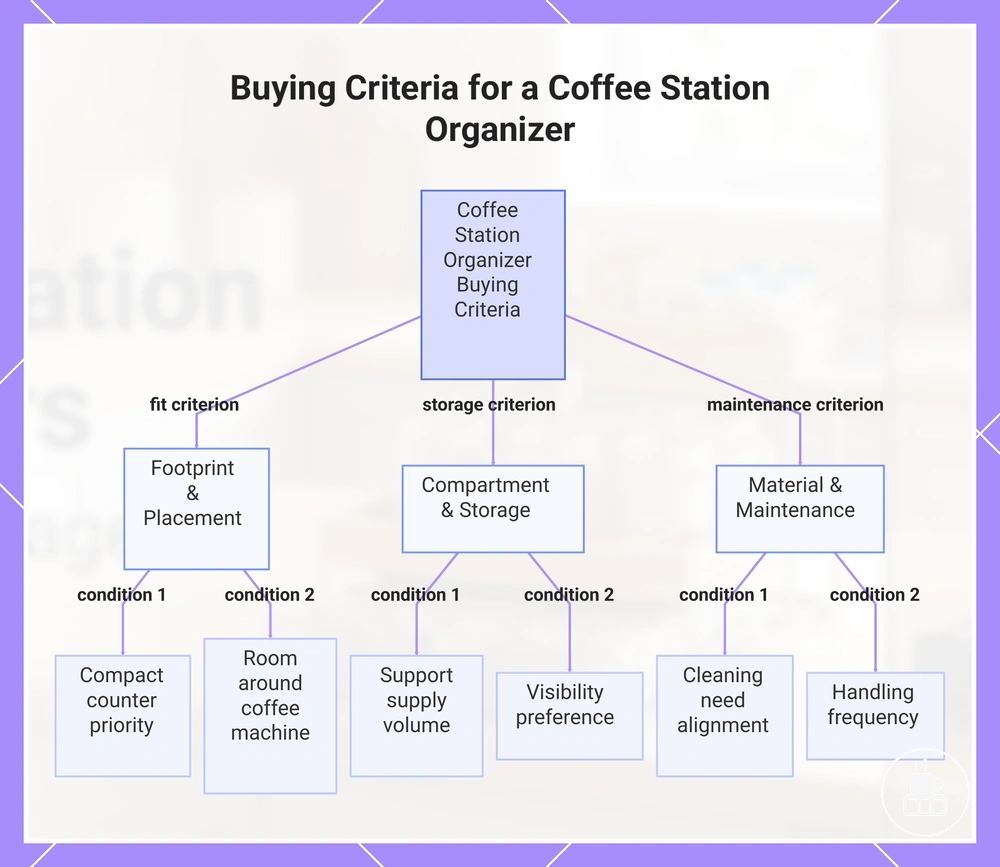
A better buying decision follows a fixed order: fit first, supply match second, access style third, material and maintenance fourth. Product examples are useful only after those criteria define the organizer profile that suits the station.
| Criterion | Accept when | Reconsider when |
|---|---|---|
| Physical fit | External dimensions fit the measured zone and leave room for machine, cabinet, outlet and drawer access. | The organizer fits numerically but blocks normal movement, controls, water access or workspace. |
| Storage match | Compartments fit the regular-use cups, pods, packets and accessories without crowding. | Capacity depends on stacking, wedging or using large sections for items that do not fit the layout. |
| Access format | Drawer, tier, shelf, tray or caddy access matches how often supplies are used and whether visibility matters. | The preferred appearance makes routine items slower or harder to retrieve. |
| Material and care | The material, finish and construction suit expected wiping, moisture and handling. | The required maintenance is unrealistic for the placement environment or use frequency. |
| Footprint versus capacity | The organizer holds normal-use supplies while preserving enough counter space to prepare coffee. | Extra capacity removes useful work surface or forces the organizer into an awkward location. |
Use the table as a rejection filter: if a product fails physical fit or blocks machine access, its material, appearance or extra capacity should not outweigh that mismatch.
After fit passes, compare compartment layout against the supplies that stay on the counter most often. This prevents a larger organizer from winning simply because it has more nominal storage.
For a deeper selection workflow, see how to choose a coffee station organizer.
The best organizer is the one that meets the station’s measured constraints with the least access friction, not automatically the largest, most decorative or most heavily compartmentalised option.
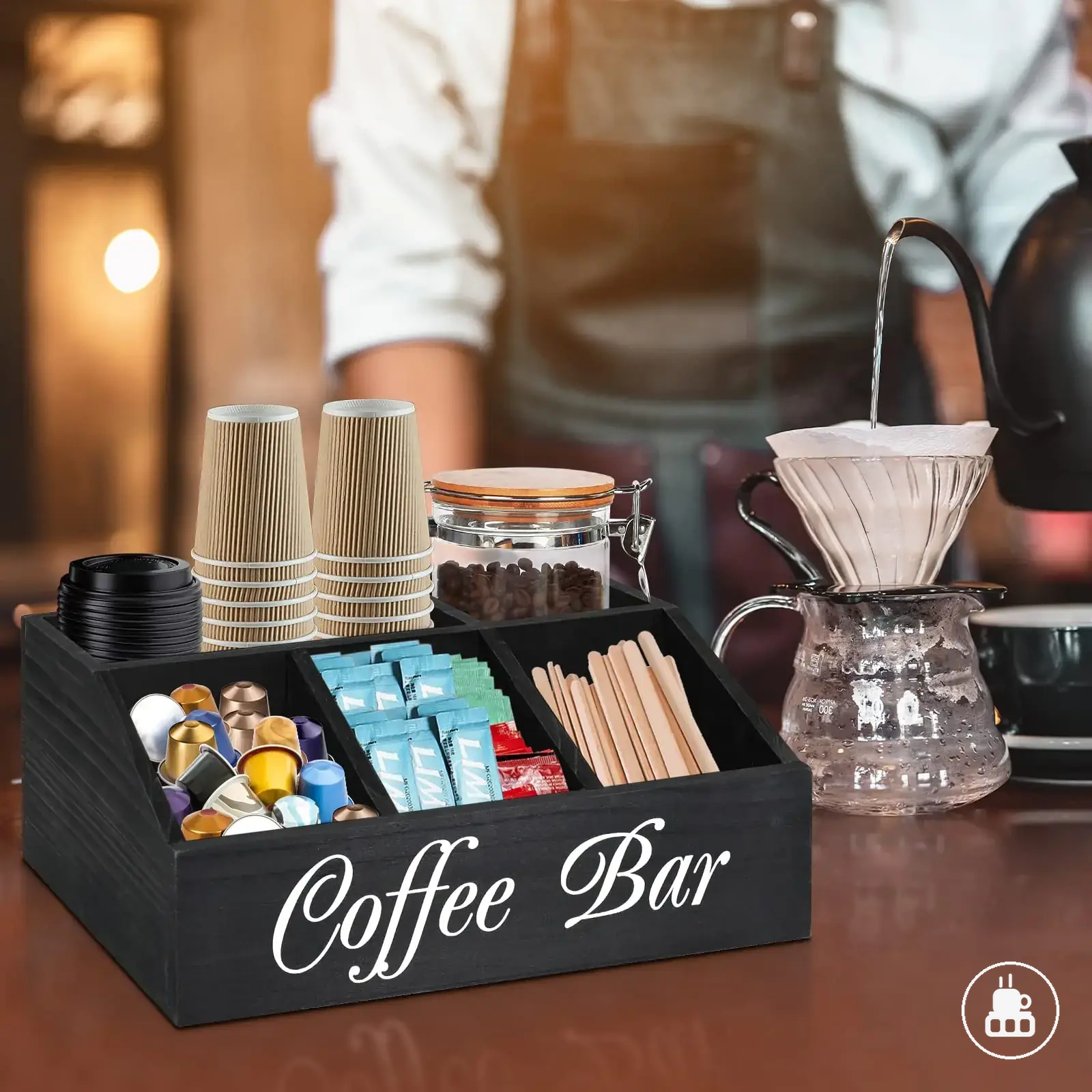
The products below are examples for comparing organizer formats and materials after you have applied the fit, storage and access criteria. Before following an offer, verify the product dimensions, compartment details and care information against your own requirements.
The chart below summarises the buying sequence by fit, storage suitability and maintenance so the product examples remain subordinate to the decision criteria.